13 March 2009: Parkas Diwas:
Sri Satguru Partap Singh Ji Maharaj
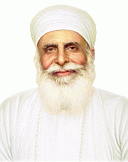 Indeed, there are very few individuals to whom is given the gift of attaining a
combination of excellent virtues and distinctive qualities which establish the
ideal concept of a perfect, all-embracing character. The influence of such
people has been so profound that in spite of their numbers being so few, without
such people, the history of mankind would have been very different. The ideal
person is inherently endowed with a combination of much wisdom, esoteric
knowledge, tradition and spiritual truth that has been infused already into the
soul previously, and which has finally blended together to diffuse as one whole.
His Holiness Satguru Partap Singh Ji belonged to this galaxy. (www.sikh-heritage.co.uk)
Indeed, there are very few individuals to whom is given the gift of attaining a
combination of excellent virtues and distinctive qualities which establish the
ideal concept of a perfect, all-embracing character. The influence of such
people has been so profound that in spite of their numbers being so few, without
such people, the history of mankind would have been very different. The ideal
person is inherently endowed with a combination of much wisdom, esoteric
knowledge, tradition and spiritual truth that has been infused already into the
soul previously, and which has finally blended together to diffuse as one whole.
His Holiness Satguru Partap Singh Ji belonged to this galaxy. (www.sikh-heritage.co.uk)
Satguru Pratap Singh Ji's birth was foretold by Satguru Ram Singh Ji - "that
although I will not have any sons but Budh Singh (ie Satguru Hari Singh Ji,
Satguru Ji's younger brother) will be bestowed with sons and his elder son will
be a possessor of exceptional divine qualities
"
Satguru Pratap Singh ji was born in Bhaini Sahib on 9th March 1890
(corresponding to Chet Vadi Teej of 1946 Bikrami) to Mata Jivan Kaur Ji. Naming
him Partap (Glorious) Singh, Satguru Hari Singh Ji declared "he will
possess an amazing ecclesiastical personality and will be a great spiritual
mentor and prominent luminary in the field of idealism"
The young Partap Singh showed an amazing capacity to memorize and by the age
of seven he could recite most of the scriptures and historical books by heart.
It is said that He could memorize one Asht Padi of Sukhmani Sahib during a
horse ride of one mile. Satguru Hari Singh Ji once had said, "Partap Singh
does not require any teaching, He is born with all the knowledge."
On 17th May 1906, Sri Satguru Pratap Singh Ji became the Head of the Namdhari
Sikhs. He was just seventeen years old then. Under his dynamic leadership, the
Namdhari movement gained momentum. Satguru Pratap Singh Ji became a powerful
messenger of peace for humanity and an outstanding promoter of justice,
truthfulness and courageousness.
In 1909 he got married to Mata Bhupinder Kaur Ji, and two sons, Beant Ji (Sri
Satguru Jagjit Singh) and Ballo Ji (Sri Maharaj Bir Singh Ji).
The flame of struggle for independence lit by Sri Satguru Ram Singh Ji was
kept burning by Satguru Partap Singh Ji till the country achieved its
independence. He decided to give support to the Congress party because of the
ideological similarities in achieving the goal of Independence.
Satguru Ji's love and devotion to his country aside, He was on the other hand
fully committed to his religion, and was not willing to compromise on any basis
where the doctrines of his revered religion were in question.
"Don’t criticize others, preach your own
virtues."
He had great love for animals and immense talent for horse riding. His cows
and buffaloes bagged numerous prizes in competitions throughout India. Similarly
his race-horses earned immense pride on the Indian racecourses, winning many
prestigious prizes.
He abolished the dowry system, which was crippling the Sikhs and made the
marriage ceremony as simple as possible and affordable to the masses. The mass
marriages system was started in various religious congregations.
Sri Satguru Partap Singh Ji was a great lover of Indian classical music. The
practice of singing in praise of God started by Guru Nanak himself and reached
its climax in the time of Satguru Partap Singh Ji. He always advocated singing
Gurbani in the same Raga, in which it had been originally composed. He
established ‘Namdhari Sangeet Vidyalaya’ at Sri Bhaini Sahib to create
talent amongst the youngsters. By virtue of that the Namdhari world now boasts a
young generation of classical music maestros whose proficiency in playing
various musical instruments is second to none. In order to promote close
co-operation and understanding of different sects, he organized ‘Gurmat
Sangeet sammelan’ in 1933. Eminent musicians from different parts of the
country thronged the holy place of Sri Bhaini Sahib to participate in the
Sammelan. Thereafter organization of such functions became a regular routine.
He started the practice of ablution and purification (Such Sodh) and inspired
his disciples to lead a puritan life. In 1940, Sri Satguru Partap Singh Ji laid
down the tradition of meditating on the Name of God (Naam Simran) for one hour
in the afternoon, recite Bani and attend in religious assembly to gain inner
strength.
Some of the many other achievements of Satguru Pratap Singh Ji were:
- Satguru Partap Singh Ji played a vital role in the passing of The
Sikh ‘Anand Marriage Act’ in October, 1909.
- At the Holla moula fuction of 1921 at Mukatsar Satguru Pratap
Singh Ji formed the Namdhari Darbar. The 33 members of this
darbar were bestowed the responsibility to keep the Namdhari
religious, social and political movement alive. It was to make contact
with other political parties and deal with various official works.
Maharaj Gurdial Singh Ji was appointed the first Chief of the Namdhari
Darbar. The Darbar continues to function even today.
- Under the patronage of Satguru Partap Singh Ji his younger brother
Maharaj Gurdial Singh Ji started the weekly Satyug in Punjabi on 26th
of May, 1920. ‘Satguru Ram Hari Press’ was then set up to
facilitate the publication of Satyug and promotion of Punjabi language
in 1925
- Under his powerful perception and personality the British eventually
succumbed, and had to remove all restrictions imposed on Bhaini Sahib
on 23rd May 1923.
- His stand against the British kept on with various meetings at
Malerkotla and other key towns. The Congress annual conference at
Lahore on 31st December 1929 was very significant which was to pass
the resolution of self rule, but was boycotted by Baba Kharak Singh
and some sects of Sikhs but Satguru Partap Singh Ji along Mata Jeewan
Kaur J and his contingent of Sikhs supplied one hundred horses and
supplied food for millions of agitators thus making the procession a
most significant and historical event in the Indian History.
- During the 1937 general election Satguru Ji openly declared his
support for the Congress Party and its fight for freedom. These
elections were held in spite of opposition by various capitalists and
rich organisations
- The State Peoples Conference was held in February, 1939 at
Ludhiana. Satguru Pratap Singh Ji personally participated in the
procession alongside many political leaders including Pandit Jawahir
Lal Nehru and Dr. Rajender Prasad.
- After the State Peoples conference Pandit Nehru, Dr. Rajinder
Prashad and other prominent personalities paid a visit to Sri Bhaini
Sahib, where the Namdhari Shaheed (Martyrs) Paintings were exhibited.
Pandit Nehru and the others were very impressed with the paintings and
the historical facts behind each painting. Pandit Nehru became
intensely emotional on learning how the Kukas were blown at Malerkotla,
he could not stop tears coming out of his eyes. The martyrdom of
Namdhari Sikhs and Satguru Ram Singh Ji's non-violent fight against
the British rulers was finally homed into his heart.
- During the Second World War, the British officials approached
Satguru Partap Singh Ji to allow the Namdhari Sikhs to join the army.
Satguru Partap Singh Ji refused to consent to their request with the
remarks "Our tenets of belief and political approach are opposed
to each other. You have desecrated Sri Bhaini Sahib for which you
cannot be pardoned. You are wasting the wealth of our country on
unwanted wars".
- Satguru Ji was one of the first individuals who made serious
attempts to bring together all the different Sikh factions, as well as
unity between Hindus, Sikhs and Muslims. The 'Sri Guru Nanak Naam Leva'
Conference was held in 1934 and this was to consolidate the discordant
Sikh community much closer to each other. This achievement was a
milestone in history of Sikhism.
- In 1943, under the chairmanship of Seth Jugal Kishore Birla the
Hindu-Sikh Unity conference was held at Sri Bhaini Sahib. Later
'Hindu, Sikh, Muslim Unity' conference was also held and proved to be
a major success.
"It is my duty that I should keep on making efforts to
achieve unity. To put an end to the existence of others is to take
responsibility of the Almighty’s fury upon one’s own shoulders. Nobody can
kill any one without His will. Why should we not march ahead together with each
other"
(Satguru Ji on Unity)
- Satguru Pratap Singh Ji foresaw the catastrophe which would unfold
with the partition. He acquired 19,890 acres (bighas) of land in
District Sirsa in January, 1947 prior to independence. After
independence the Sikh refugees from Pakistan, were provided them
shelter, food, clothing and all other amenities. He also distributed
the acquired land and money at Sri Jivan Nagar. This region of Sri
Jivan Nagar is now one of the best agricultural areas in the district.
- Satguru Partap Singh Ji had always been longing for early
reappearance of Satguru Ram Singh Ji as promised by him. For
accomplishment of this sacred objective, he started continuous
meditation of Naam Simran (Vamis) at Sri Bhaini Sahib in 1933 and at
Sri Jiwan Nagar in 1947. These Varni’s are continuing (Naam Simran)
without interruption till today.
- The modern co-operative farming and Panchayati Raj is a developed
form of tradition set by Satguru Ji. He always gave prominence to the
Panchayats, he advised the Namdhari Sikhs not to go to the courts, and
get their disputes settled by their own Panchayats.
- Other than the countless visits to different parts of the country,
he paid one visit to Singapore, four to Africa and twenty-two to
Thailand. In fact, real religious, cultural and social stability
was established amongst the Sikhs during the period of Satguru
Partap Singh Ji visits abroad. He showered his virtuous blessings on
the suffering humanity and redeem them of woes and worries
- Satguru Ji was always in favor of banning cow slaughter in
India. His devotion to this cause was illustrated when in 1937, the
British government decided to open butcheries equipped with the modern
machines. He prayed to the Almighty through a grand havaan Yug. For 14
days, five hundred sikhs chanted Chandi-Di-Var composed by Sri Guru
Gobind Singh Ji 125,000 times. With the completion of the grand Havana
Yug the British government, announced the cancellation of
their plan to open the slaughter house. Such was Sri Satguru Partap
Singh Ji’s spiritual supremacy.
- Satguru Pratap Singh Ji's generosity was unsurpassed. When refugees
fled Pakistan after independence Satguru Ji provided them
shelter, food, clothing and all other amenities. He distributed
agricultural land free of cost to a huge number of landless tillers.
His Holiness Sri Satguru Partap Singh Ji always gave a warm welcome to
guests and showered his pious blessings upon them and when Dr Rajindra
Prasad went to him, Satguru Ji gave him 500 yards of Khadi, 100 maunds
of wheat for the earth- quake sufferers of Bihar. In 1954-55, when
Pandit Nehru visited Sri Bhaini Sahib, Satguru Ji gave him 200 bags of
rice for the draught stricken people of Bengal. In 1956, he
distributed food, and clothes to the flood stricken people of Punjab
and other part of the provinces.
- The weekly Satyug paper having started in 1920, the means of
communication and publicizing the activities of the Namdhari freedom
struggle was now available. Maharaj Gurdial Singh Ji, the youngest
brother of Satguru Partap Singh Ji played a key role in publishing the
sufferings of the Namdhari Sikhs. Sant Nidhan Singh Ji Alam and Sant
Inder Singh Ji Chakravarty were the other notable literary figures,
who joined hands with Maharaj Gurdial Singh Ji in writing and
publishing the Namdhari History. This process of writing attracted
writers like Sant Taran Singh Vehmi, Sant Kalah Singh, Chanda Singh,
Bishen Singh Historian, Master Nihal Singh, Pritam Singh Kavi, Pritam
Singh Panchi and many others. As a result of their research, many a
notable books are now available for the readers;
He left for his heavenly abode on 22nd of August, 1959.
